
Express from QLD|2pm cutoff
How we test
Every VantaLab product is blind-tested by PepScan Australia, and every certificate is public. Here is exactly what that means, and how to check it yourself.
From sample to certificate
- 01
Sent blind
We send each product to PepScan Australia, an independent laboratory, without saying what it is.
- 02
Identified and measured
The lab identifies the compound itself and measures its purity by HPLC (high-performance liquid chromatography).
- 03
98% or it doesn’t sell
Anything that comes back below 98% purity is rejected and never listed.
- 04
Published
The certificate goes into the public COA Library, where anyone can read it and check it with PepScan.
 (opens full size in a new tab)
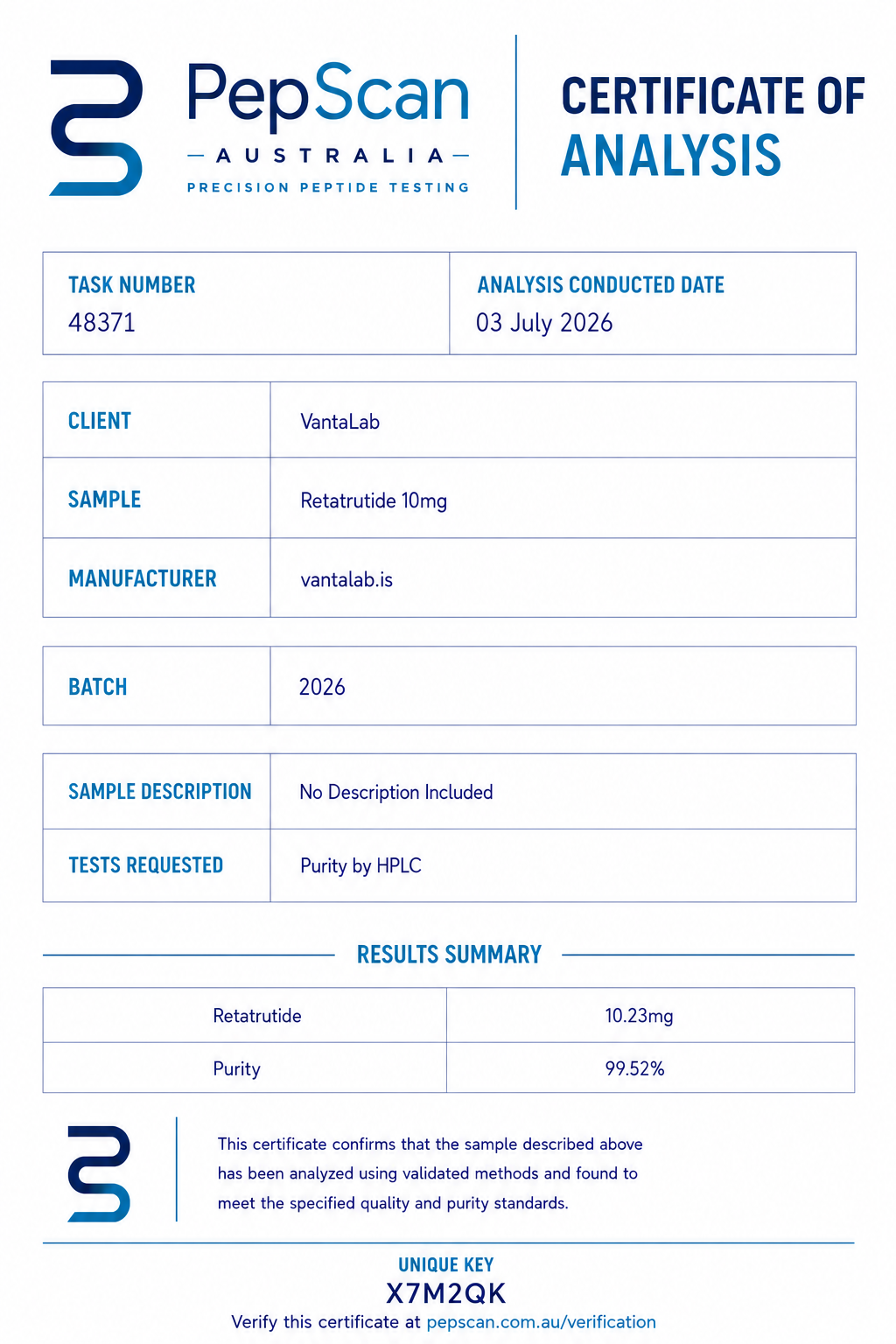
A real certificate: Retatrutide 10mg.
How to read a certificate
- 1
Task number and date
PepScan’s own reference for the test, and the day it was run.
- 2
Client and sample
Who the test was for (VantaLab) and the sample tested, with its strength.
- 3
Manufacturer
Shows vantalab.is, our short domain, which redirects to vantalab.com.au.
- 4
Tests requested
Purity by HPLC: how the sample was analysed.
- 5
Results summary
The compound identified, the amount measured, and its purity as a percentage.
- 6
Task number and unique key
Printed at the top and foot of each certificate. Enter both at pepscan.com.au/verification to confirm the certificate is genuine.
Why blind testing matters
When a lab is told what a sample should be, a result can only confirm or deny that. When it isn't told, it has to identify the compound from scratch. A blind result that names the right compound at the right purity is much harder to get wrong, or to fake.
HPLC separates a sample into its parts and measures each one. A clean product shows one dominant peak; its share of the total is the purity printed on the certificate.
Read it, then order it
Every product page shows its own certificate. Orders before 2:00pm AEST on business days ship the same day.
VantaLab research peptides are blind-tested by PepScan Australia, with purity measured by HPLC and a 98% minimum. Every product has a public Certificate of Analysis in the COA Library. For research purposes only. Not for human consumption.